
English| EUR
Suggested for you
More currencies
Choose a language
The Cao Bang Loop is not a single ticketed site but a multi-day motorbike route through northern Vietnam's karst highlands. Entrance to the region is free, yet the journey demands a budget for transport, fuel, meals, and overnight stops. This guide explains what you will pay and where those costs fall.
Quick answer
Entrance to the Cao Bang Loop is free—the loop is a touring route across Cao Bang Province, not a gated attraction. Your cao bang loop price comes from motorbike rental (150,000–250,000 VND per day), fuel (roughly 100,000 VND for 200 kilometers), meals (50,000–150,000 VND each), and guesthouse lodging (150,000–400,000 VND per night). A three-day loop typically totals 1,500,000–3,000,000 VND per person, depending on comfort level and route length.
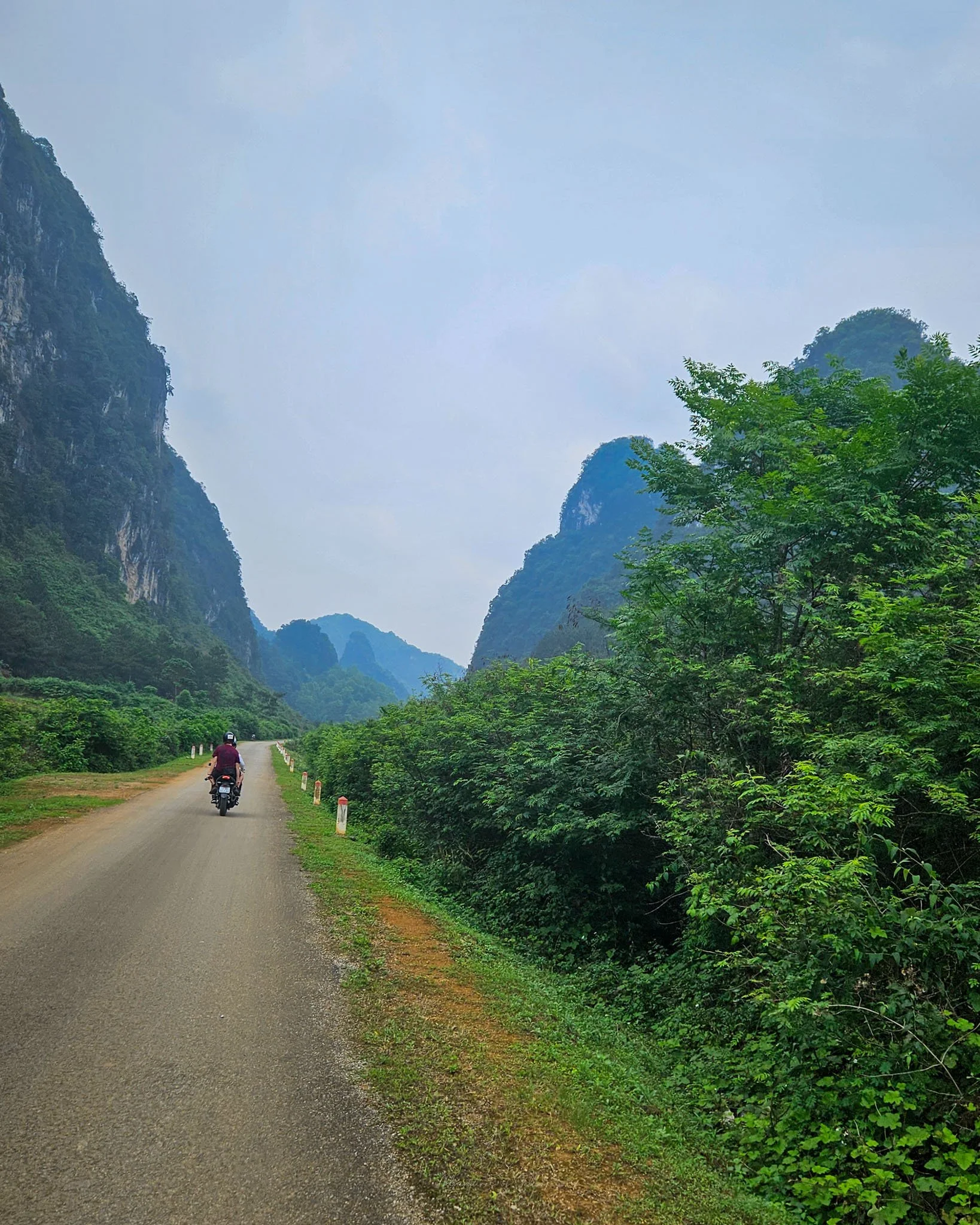
The Cao Bang Loop threads through one of Vietnam's least touristed highland zones, a crescent of limestone massifs, terraced valleys, and roadside Tay villages that sees a fraction of the traffic flooding Ha Giang to the west. The loop itself is a concept, not a boundary—riders self-navigate a rough triangle linking Cao Bang town, Ban Gioc Waterfall, Ba Be Lake, and the karst corridors in between. Because the route crosses open provincial roads rather than a ticketed park, the cao bang loop price is the sum of your daily operating costs, not a single entry fee. Motorbike rental anchors the budget. Semi-automatic scooters rent for 150,000 to 200,000 VND per day in Cao Bang town; manual bikes with off-road clearance push toward 250,000 VND. Fuel economy on the twisting climbs averages fifteen to twenty kilometers per liter, so two hundred kilometers of riding—a typical daily distance—burns roughly five liters at 20,000 VND per liter. Guesthouse beds in Quang Uyen, Trung Khanh, and Pac Bo range from bare 150,000 VND fan rooms to 400,000 VND en-suite doubles; homestays in Phuc Sen or Tra Linh often include dinner and breakfast for a flat 300,000 VND. Meals at roadside com pho stalls cost 50,000 to 80,000 VND; sit-down restaurant dinners in Cao Bang or Ba Be climb to 150,000 VND with beer. Ban Gioc Waterfall, the loop's marquee landmark, charges its own 80,000 VND site entry and 30,000 VND for the electric-cart shuttle to the falls viewing terrace. Ba Be National Park levies a separate 60,000 VND entrance and 180,000 VND for a two-hour boat trip across the lake. These stops add 350,000 to 400,000 VND to the total loop cost per person. Nguom Ngao Cave near Cao Bang town takes another 30,000 VND. Riders who extend the loop to include Pac Bo Cave—Ho Chi Minh's revolutionary base—pay 20,000 VND there. Understanding the cao bang loop price means tallying these discrete fees alongside your daily rental, fuel, food, and lodging, then multiplying by the number of days you ride. Three-day loops cover the core triangle; four- or five-day itineraries add Ba Be Lake and the northern Pac Bo spur, lifting the total accordingly. The loop's cost structure rewards self-sufficiency. Riders who pack snacks, fill water bottles at guesthouses, and choose fan rooms over air-conditioned hotels can complete a three-day circuit for under 1,500,000 VND. Those who upgrade to boutique lodges, hire local guides, or extend the route to five days should budget closer to 3,000,000 VND. Either way, the journey remains one of the most affordable multi-day motorbike routes in Southeast Asia, its price shaped less by tourism surcharges than by the practical costs of moving through remote terrain.
“The loop's price is the sum of your daily operating costs, not a single entry fee.”
A Cao Bang Loop trip budget primarily consists of daily variable costs for transportation, lodging, and nourishment. Expenses vary based on vehicle choice and individual accommodation preferences.
How to spend less
Verdict: Expect a realistic daily budget between 700,000 VND and 1,300,000 VND per person depending on your comfort level.
Cao Bang is located in Northeast Vietnam, with most travelers arriving from Hanoi via national highways. Reaching the city serves as the standard starting point for the mountain loop.
QL3 (National Highway 3) from My Dinh Bus Station to Cao Bang City
QL3 or CT07 (Hanoi–Thai Nguyen Expressway) to Cao Bang City
Private hire from Hanoi or Noi Bai International Airport
Plan your journey to arrive within the best arrival window of 08:00–17:00 to ensure visibility for navigating regional roads.
The optimal time to navigate the Cao Bang Loop is during the dry season months of April and October, when stable weather conditions favor visibility on mountain passes. Travelers should plan their daily movements within the best arrival window of 08:00–17:00 to maximize daylight for driving.
Stable, 20°C–28°C
Clear skies and dry roads offer the best conditions for motorcycle touring.
Humid, 25°C–32°C
Rainfall can reduce visibility and make mountain passes slippery.
—
Adhere to 08:00–17:00 to ensure navigation occurs during peak daylight hours.
Cold, 5°C–15°C
Temperatures drop significantly, requiring specialized gear for mountain travel.
Verdict: The best period for the Cao Bang Loop is April or October, targeting daily travel between 08:00 and 17:00.
Prepare documentation, safety gear, and navigation tools before setting out on the multi-day mountain route.
Everything you need to know about cao bang loop price
The official cao bang loop price is 0 VND because the region is a public area rather than a ticketed attraction. Visitors do not pay any entry fees to travel through the province and explore its winding mountain passes.
There is no entrance fee for the Cao Bang mountain circuit as it consists of public roads and local communities. You may encounter specific fees only if you choose to visit individual attractions like Ban Gioc Waterfall or Nguom Ngao Cave.
While the cao bang loop price for access is zero, your total trip cost will depend on motorcycle rental, fuel, and accommodation expenses. Planning for these daily logistics ensures a smooth journey through the karst landscapes.
Travelers often mistake the cao bang loop price for a guided tour fee, but the route is open to independent explorers. Ensure you have your international driving permit and enough cash for local homestays and meals along the way.
The best arrival window for driving is between 08:00 and 17:00 to maximize visibility on the roads. Navigating these limestone peaks during daylight hours provides the safest experience for all motorists.
Exploring the region with children is possible, but the winding mountain roads require careful consideration of safety and comfort. Many families choose private cars over motorcycles to navigate the limestone terrain safely.
Cao Bang Loop Map
Read more GuideCao Bang Loop Route
Read more Tickets & toursCao Bang Loop Tour Companies
Read more GuideCao Bang Loop Packing List
Read more Tickets & toursCao Bang Loop Easy Rider
Read more GuideCao Bang Loop vs Ha Giang
Read more Tickets & toursCao Bang Loop from Hanoi
Read more GuideCao Bang Loop Police Checkpoints
Read more